
Seminar Series 2nd Edition
© Clarote & AI4Media / Better Images of AI / Labour/Resources / CC-BY 4.0
Following the success and strong interest in last year’s events, the online seminar series “Cross-Cultural Approaches to Desirable AI” continues this year. The series aims to encourage intercultural and interdisciplinary discussion on the ethics of artificial intelligence (AI). Its primary focus is to support and develop research on AI and social justice, particularly from intersectional feminist and anti-racist perspectives. “Cross-Cultural Approaches to Desirable AI” is a collaboration between the Universities of Cambridge, Bonn, and Tokyo, and the University of Europe for Applied Sciences.
We bring together researchers working on AI and digital technologies of all career stages from a variety of disciplines. The series seeks to bridge perspectives from the arts and sciences, with a particular emphasis on encouraging students with technical and engineering backgrounds to engage with ethical issues surrounding AI.
The concept of “desirable AI” refers to the development of technology that places social justice and environmental sustainability at its core. Rather than simply optimizing technology, the goal is to design AI that reflects and respects the diverse values and needs of different cultures. This approach requires acknowledging different worldviews while avoiding issues such as cultural appropriation and “diversity washing” in technology development.
This year, we continue our exploration of cross-cultural and ethical perspectives on AI with new themes and areas of inquiry. Rather than centering sessions on geographical regions, we focus on cross-cultural dialogue around shared thematic questions. To do so, we bring together experts from across different communities and disciplines. Among the topics we will highlight are: Spiritual traditions and AI ethics beyond the individual, bringing Buddhist and Ubuntu principles into dialogue with questions of technology and humanity, and Contextualised perspectives on large language models, examining bias, erasure, and situated methods across languages and regions.
By extending these conversations, the series continues to foster a pluralistic and inclusive vision of AI — one that remains deeply attentive to cultural context, social justice, and the shared pursuit of desirable futures.
Dates and Registration
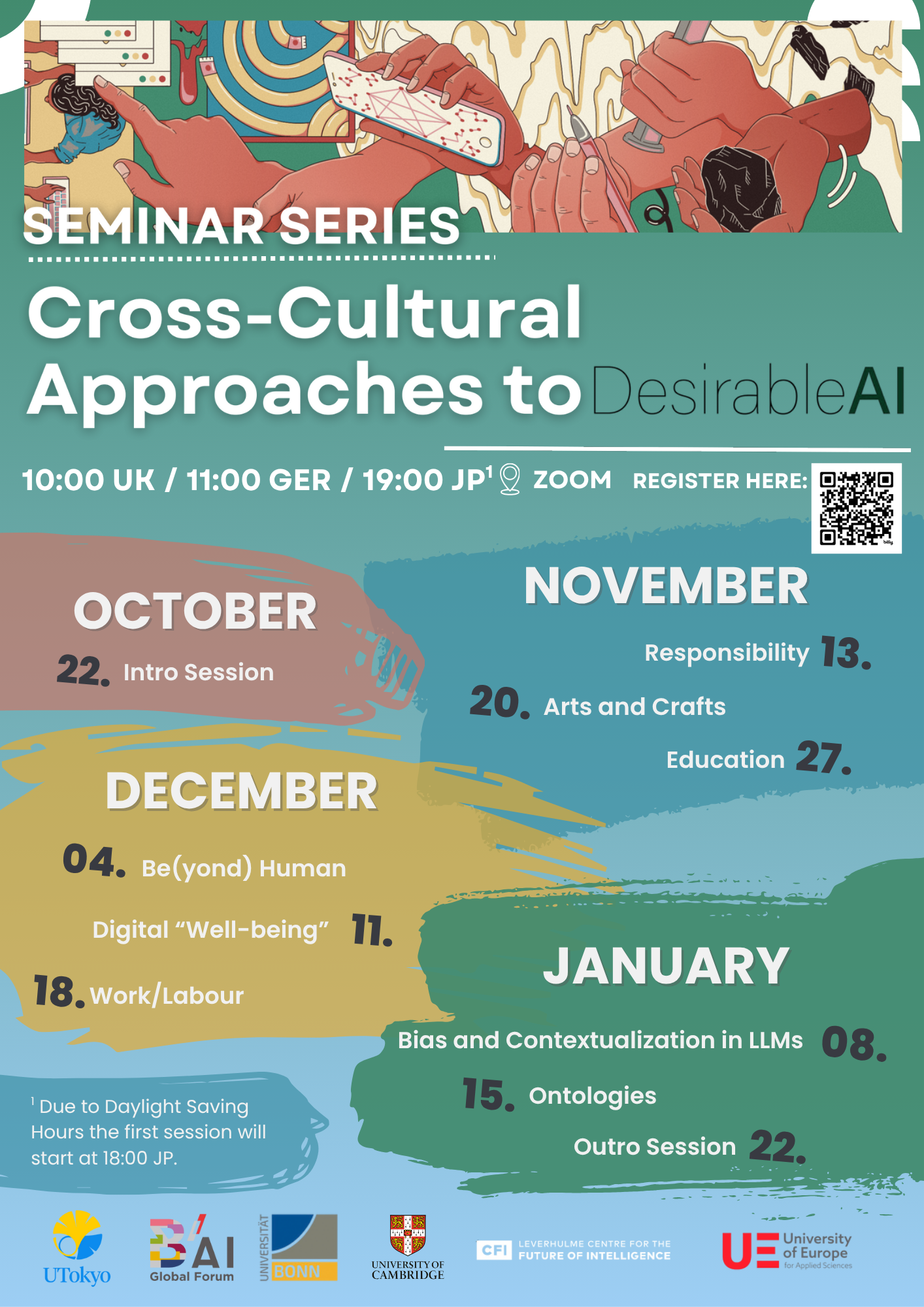
The seminar series will be held on Thursdays via Zoom at 10:00 UK / 11:00 GER / 19:00 JP*, starting on October 22nd (Wed.). Each session will last 120 minutes.
*Please note that due to daylight saving hours, the intro session on October 22 will start at 10:00 UK / 11:00 GER / 18:00 JP.
If you would like to attend any of the sessions, please click here to register for our email list where we will share Zoom links and information on upcoming sessions.
Contact
If you have any questions, please contact the respective address by replacing the [at] with an @:
University of Europe for Applied Sciences, Jiré Emine Gözen: jire.goezen[at]ue-germany.de
UTokyo/B’AI Global Forum Office, Sunjin Oh: bai.global.forum[at]gmail.com
University of Cambridge/LCFI, Eleanor Drage: desirableai[at]gmail.com
University of Bonn/CST, Christiane Schäfer: desirableai[at]gmail.com
Schedule
-
-
Thomas Metcalf (IWE, Uni Bonn): Sustainability and Political Education.
Sebastian Gehrmann (Bloomberg LP): tba
Alina Mozolevska (Petro Mohyla Black Sea State University; Wissenschaftskolleg Berlin): Media Witnessing and Moral Responsibility: VR, AI, and the Ethics of Seeing in the Russo-Ukrainian War.
Titlope F. Ajayi (Institute for Security Studies): Whose Peace and at What Cost? Feminist Interrogations of AI in African Security Policy.
Chairs: Eleanor Drage (LCFI, Cambridge) and Jiré Emine Gözen (UE).
-
Puja Aanand and Alok Bhasin (Pearl Academy): Preserving the Past, Designing the Future: A New Paradigm for Design Education and SDG Alignment.
Goda Klumbyte (University of Kassel; Weizenbaum Institute): Material critique, abstract creativity: working towards a transdisciplinary critical technical practice.
Chairs: Eleanor Drage (LCFI, Cambridge) and Jiré Emine Gözen (UE).
-
Marisol Flores-Garrido and Marcela Moales-Magaña: Situated Appropriations of AI: Ethical Guidelines from a Global South University.
Christian Stracke (Uni Bonn): (Ethical) AI and (School) Education.
Eman AbuKhousa (UE Dubai): Learning Design for Global Minds and Desirable AI.
Chairs: Eleanor Drage (LCFI, Cambridge) and Jiré Emine Gözen (UE).
-
Wakanyi Hoffman (Inclusive AI Lab, Utrecht University): Beyond Big Data: Learning to Read AI as a Relational Field using Clariscopic Ubuntu Vision.
Shoukei Matsumoto: Human Literacy in the Age of AI.
Chairs: Ai Hisano (B’AI Global Forum, UTokyo) and Christiane Schäfer (CST, Uni Bonn)
-
Mamun Rashid (SYNC, Ithra): Offline Is the New Luxury? Exploring the Right to Disconnect - Connect.
Matthew J. Dennis (TU Eindhoven): Who is Responsible for Digital Well-Being?
Julia Maria Mönig (CST, Uni Bonn): The luxury of digital well-being: privacy as privilege.
Chairs: Ai Hisano and Sunjin Oh (B’AI Global Forum, UTokyo)
-
Jurgita Imbrasaite (CST, Uni Bonn): AI and the Critique of the Modern Labor Paradigm.
Avantika Tewari (Jindal Global Law School): The Paradox of Data Prosumerism: Relocating Reproductive Labor in the Platform Economy.
Jussara Rowland (INESC-ID): Making Sense of Digital Identity: Data, Mediation, and the Construction of the Digital Self.
Chairs: Sunjin Oh (B’AI Global Forum, UTokyo) and Christiane Schäfer (CST, Uni Bonn)
-
Sunjin Oh (B’AI Global Forum, UTokyo): Intersectional Bias in Japanese Large Language Models.
Nicholas Kluge Corrêa (CST, Uni Bonn): All Too Perfect: Bias and Aspiration in Persona Generation with LLMs.
Kyungjoon Oh (Hanyang University): Detecting the Gap Between Model and Society: A Framework for Evaluating Occupational Bias in Text-To-Image Generation.
Chair: Ai Hisano (B’AI Global Forum, UTokyo)
-
Prashant Kumar (CST, Uni Bonn): Quasi Sense. Toward an Ontology of AI Outputs.
Young Woo Kwon (Korea University): The Deception of AI Ethics and its Ontological Ground.
Chairs: Christiane Schäfer and Lennard Landgraf (CST, Uni Bonn)
-